
Logo RUB
  • Institute
    • ICAMS
      • Mission
      • Structure
      • Members
      • Fellows
      • Scientific Reports
    • Departments & Research Groups
      • Atomistic Modelling and Simulation
      • Scale-Bridging Thermodynamic and Kinetic Simulation
      • Micromechanical and Macroscopic Modelling
      • Artificial Intelligence for Integrated Material Science
      • Computational Design of Functional Interfaces
      • Scale-Bridging Simulation of Functional Composites
      • Materials Informatics and Data Science
      • High-Performance Computing in Materials Science
    • Central Services
      • Coordination Office
      • IT
  • Research
    • Overview
    • Publications
    • Software and Data
    • Collaborative research
    • Research networks
    • Young enterprises
  • Teaching
    • Overview
    • Materialwissenschaft B.Sc.
    • Materials Science and Simulation M.Sc.
    • ICAMS Graduate School
    • Student Projects
  • News & Events
    • Overview
    • News
    • Seminars and Workshops
    • Conferences
  • Services
    • Overview
    • Contact
    • Open positions
    • Travel information
 
ICAMS
ICAMS
MENÜ
  • RUB-STARTSEITE
  • Institute
    • ICAMS
    • Departments & Research Groups
    • Central Services
  • Research
    • Overview
    • Publications
    • Software and Data
    • Collaborative research
    • Research networks
    • Young enterprises
  • Teaching
    • Overview
    • Materialwissenschaft B.Sc.
    • Materials Science and Simulation M.Sc.
    • ICAMS Graduate School
    • Student Projects
  • News & Events
    • Overview
    • News
    • Seminars and Workshops
    • Conferences
  • Services
    • Overview
    • Contact
    • Open positions
    • Travel information
Home » Institute » Departments & Research Groups » Atomistic Modelling and Simulation » Atomistic Simulation of Compositionally Complex Alloys

Just another WordPress site - Ruhr-Universität Bochum

Department Atomistic Modelling and Simulation Research Group

Atomistic Simulation of Compositionally Complex Alloys

The research group focuses on the atomistic simulation of compositionally complex alloys (CCAs), including related classes such as multi-principal element and high-entropy alloys (HEAs).
 
Fritz KörmannRUB, Marquard
Dr. rer. nat. Fritz Körmann

Research Group Leader

Room: 02/715
Tel.: +49 234 32 18092
E-Mail: fritz.koermann@rub.de


Research

Most materials owe their properties to chemical complexity arising from multiple elements. This applies to structural materials such as steels, superalloys, lightweight alloys, and functional systems like catalysts or batteries. Yet it is often unclear how properties change when compositions are modified—whether intentionally, for replacing critical elements, or unintentionally, during recycling. Compositionally complex alloys (CCAs) and related multicomponent materials provide a strategy to exploit chemical diversity, addressing stability, safety, sustainability, and environmental impact.
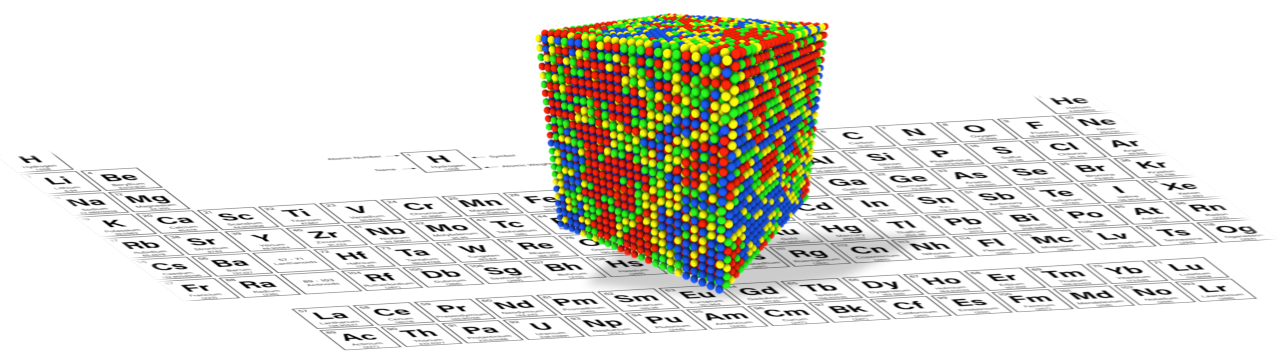
Compositionally Complex Alloys
Compositionally complex alloys are composed of several major elements.
ICAMS, RUB

The CCA group investigates mechanical, thermodynamic, and magnetic properties of such materials using first-principles and machine-learning methods in close collaboration with experimental partners. Current activities include:

  • Development of thermodynamic ab initio approaches for lattice vibrations and magnetic fluctuations,
  • Integration of first-principles and machine-learning interatomic potentials,
  • Study of interstitial defects and their effect on stacking fault energies,
  • Screening of magnetic properties of high-entropy alloys,
  • Phase stability and short-range order in multicomponent alloys.

These activities extend previous methods for unaries and ordered compounds toward complex alloys, to identify compositions with targeted materials properties.

Competences

  • Thermodynamic ab initio methods for lattice vibrations (phonon calculations, thermodynamic integration).
  • Magnetism, magnon-phonon interactions, magnetic model Hamiltonians (Monte Carlo simulations, many-body theories, Green’s function techniques).
  • Phase stability and short-range order in multicomponent alloys.
  • Steels, high-entropy alloys, and compositionally complex materials.
Members
  • Körmann, Dr. rer. nat. Fritz
Recent Publications
  • P. Kumar, F. Körmann, K. Edalati et al. Hydrogen diffusion in TiCr2H Laves phases: A combined ab initio and machine-learning-potential study. Acta Materialia, 308, 122048, (2026)
  • Z. Pei, Y. Gong, P. Singh et al. Can chemical short-range order be transformed into a practical alloy-engineering tool?. Current Opinion in Solid State and Materials Science, 41, 101254, (2026)
  • K. Glazyrin, K. Spektor, M. Bykov et al. Synthesis of high-entropy hydride from the cantor alloy (fcc–CoCrFeNiMn) at extreme conditions. Nature Communications, 17, 2622, (2026)
  • F. Körmann, A. Forslund, Y. Ikeda et al. Impact of thermal excitations on the stabilization of the disordered VCoNi alloy. Physical Review Materials, 10, 023604, (2026)
  • X. Wu, Z. Sun, W. Guo et al. Microstructural origin of the simultaneous enhancements in strength and ductility of a nitrogen-doped high-entropy alloy. Acta Materialia, 304, 121753, (2026)
  • J. Zhang, X. Xu, F. Körmann et al. Lattice distortions and non-sluggish diffusion in BCC refractory high entropy alloys. Acta Materialia, 297, 121283, (2025)

All publications

Logo RUB
  • Open positions
  • Travel information
  • Imprint
  • Privacy Policy
  • Sitemap
Ruhr-Universität Bochum
Universitätsstraße 150
44801 Bochum

  • Open positions
  • Travel information
  • Imprint
  • Privacy Policy
  • Sitemap
Seitenanfang Kontrast N