

Just another WordPress site - Ruhr-Universität Bochum
Research Group
Data-oriented materials modelling
 ICAMS
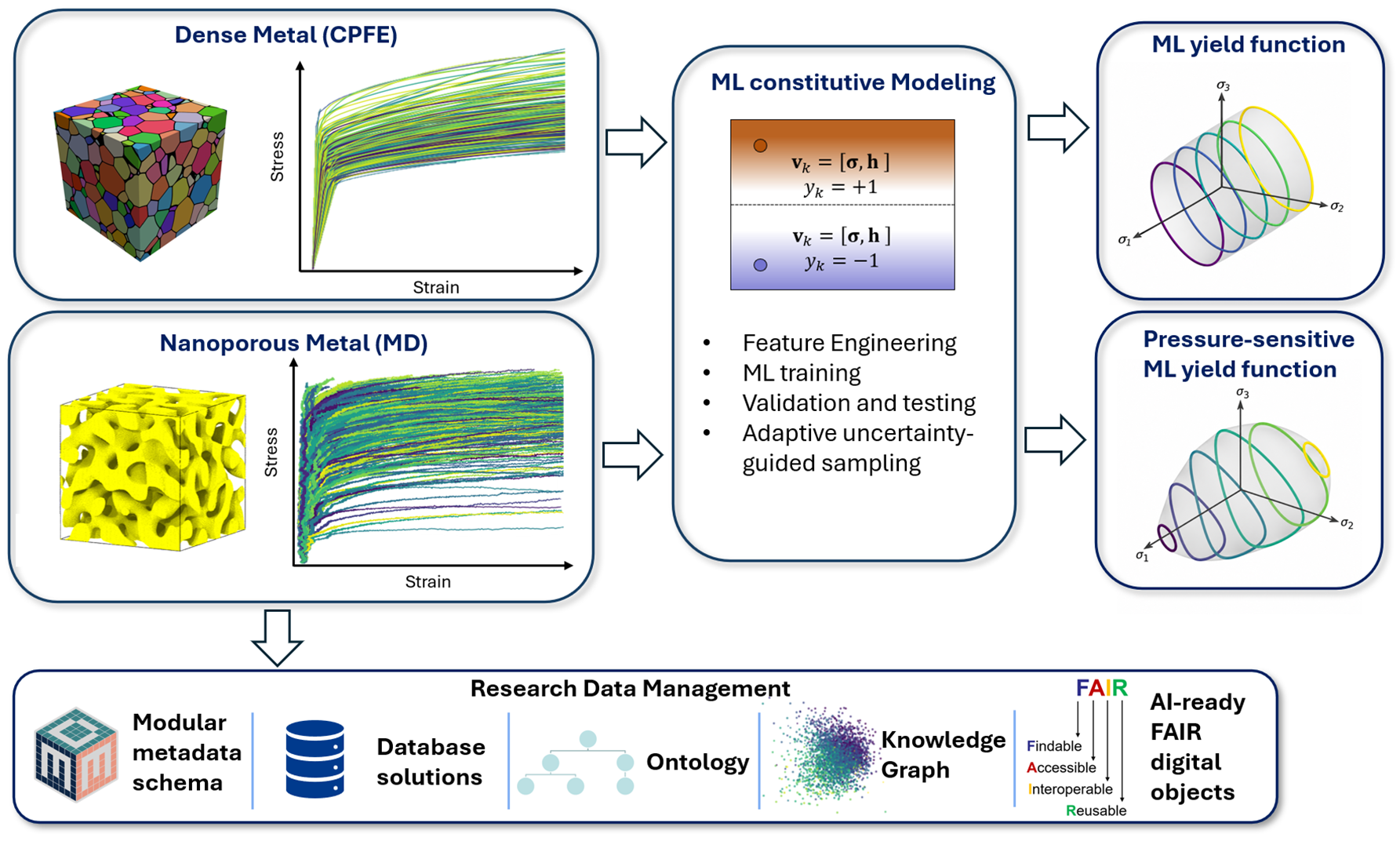
A central aim is to bridge scales by transferring information from fundamental, lower-scale simulations into constitutive descriptions for continuum modeling on larger scales. We investigate how microstructural characteristics, plastic deformation, and loading history influence the mechanical response, while developing data-driven constitutive surrogate models and active-learning strategies to reduce the computational cost of data generation and material modeling. In parallel, we develop FAIR research data management workflows, including modular metadata schemas and web-based tools, to preserve the context of simulation data, facilitate their long-term reuse, and contribute to a sustainable research data management ecosystem.
Research
ML Constitutive modeling
We develop data-driven constitutive modeling approaches to describe the mechanical behavior of metallic materials and bridge length scales by translating fundamental, lower-scale simulation data into effective continuum descriptions. Through feature engineering, machine-learning model training, and systematic validation, we aim to capture complex relationships between material state, loading history, and plastic response, including yielding and strain hardening, as well as to describe damage initiation and evolution. The resulting models are developed as computationally efficient surrogates, enabling rapid evaluation of material behavior and reducing the computational cost of higher-scale simulations. Our approaches are designed to accommodate diverse material systems and loading conditions, providing flexible constitutive descriptions without prescribing restrictive analytical forms in advance.
Active learning and efficient data generation
We develop active-learning strategies to efficiently explore high-dimensional material and constitutive spaces. By iteratively identifying informative sampling points and using feedback from predictive models to guide additional simulations, these approaches aim to reduce the computational cost of data generation while maintaining representative coverage of the investigated space. Our goal is to enable accurate and data-efficient material modeling with substantially fewer high-fidelity simulations.
Microstructure Reconstruction and Integrated Simulation Workflows
We develop computational approaches for generating realistic, statistically representative three-dimensional microstructures based on experimental characterization data, accounting for grain morphology, phase distributions, and crystallographic texture. Using tools such as Kanapy, we combine microstructure reconstruction with integrated simulation workflows that connect materials processing, microstructure evolution, and mechanical property prediction. By enabling interoperability and consistent data exchange between different simulation tools, these workflows support automated and traceable process-structure-property modeling chains.
Research Data Management
We develop structured approaches to research data management, focusing on microstructure-sensitive mechanical data and the computational workflows through which they are generated. Our modular metadata schema MiMeDat enables consistent documentation of microstructural information, simulation conditions, mechanical properties, and data provenance across different computational tools. Building on this foundation, we work on ontology alignment and knowledge-graph-based representations to establish semantic relationships between data objects, improve interoperability, and enable efficient data discovery and retrieval. Our overarching goal is to establish sustainable FAIR research data management practices that support the traceability, accessibility, and long-term reuse of scientific data for subsequent analysis and data-driven materials modeling.
Competences
- Machine-learning constitutive modeling for plasticity and damage
- Active learning and adaptive sampling of material and constitutive spaces
- Synthetic microstructure generation
- Microstructure-resolved simulations and integrated process-structure-property workflows
- FAIR research data, modular metadata schemas, ontology alignment, and knowledge graphs